Inventory Management for Ecommerce
Multi-channel inventory planning for scaling ecommerce brands. Connect Shopify, Amazon, and wholesale into one source of truth — automated forecasting, replenishment, and exception reporting, without the Frankenstein spreadsheet.
Built for ops teams managing 100–10,000 SKUs across multiple channels and regions, who’ve outgrown spreadsheets but don’t want a bloated ERP.
1-week onboarding · No long-term contract · Trusted by Craftis, HoX, Trtl, Evolve, GTE
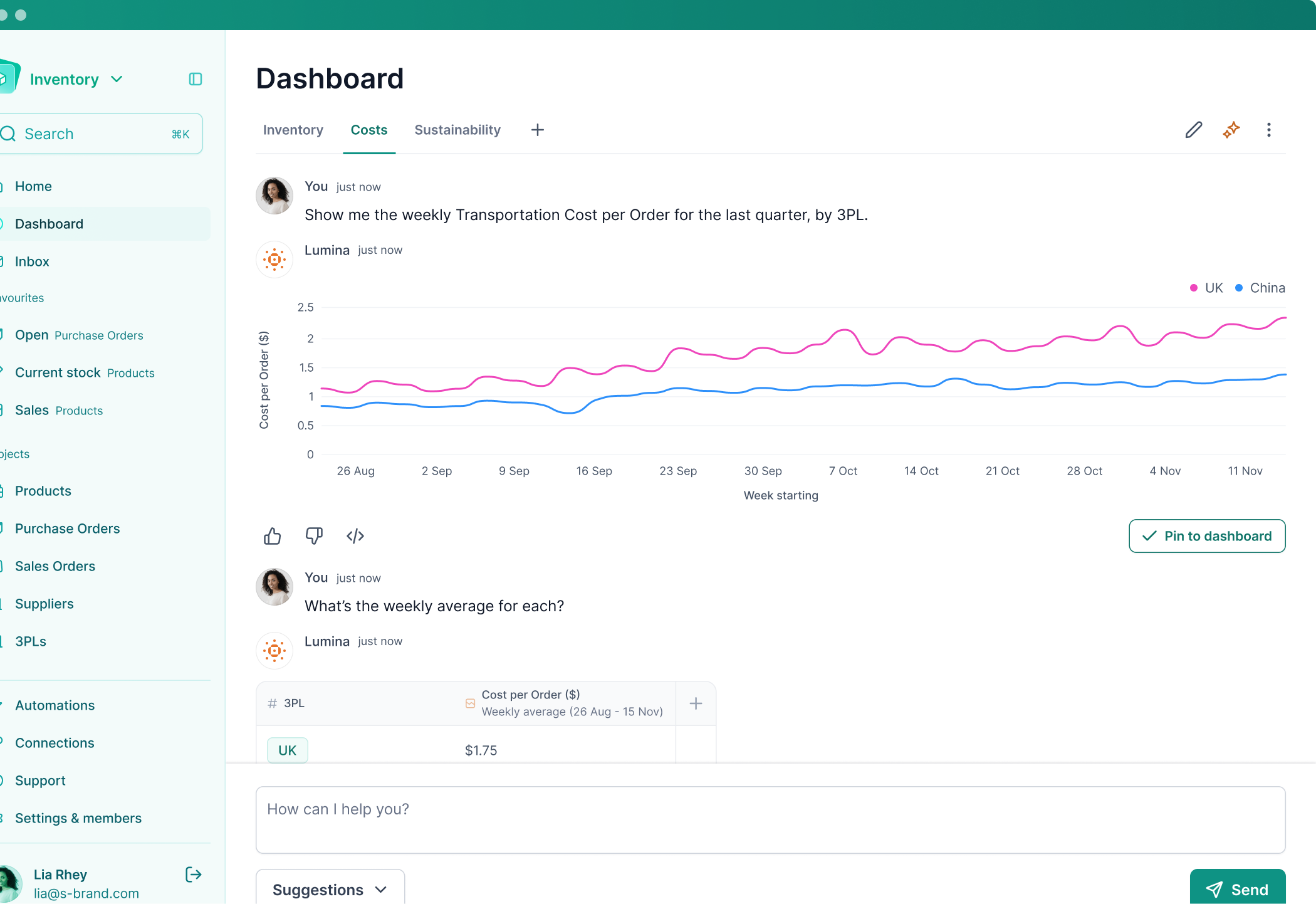
Why ecommerce inventory is harder than the apps make it look
Generic inventory apps were built for one channel, one warehouse, and a stable demand pattern. Ecommerce has none of those.
Five systems, one weekly forecast
Shopify for D2C. Amazon Seller Central for marketplace. An ERP like Unleashed or Cin7 for fulfilment. Xero for accounting. A 3PL export. Putting them together is the whole job.
Promotions that distort the forecast
A 30% sale lifts demand 4–10× for a week, then drops it below baseline for the next two. A trailing-average forecast can’t see the difference; the next reorder over-buys.
Long lead times, fast demand
14-week ocean freight against a 2-week TikTok-driven demand spike. Either you carry expensive buffer or you stock out at exactly the wrong moment.
Bundles, kits, and variants
A bundle on Shopify is three SKUs in the warehouse. A fulfilment app that doesn’t handle this forces workarounds that break at scale.
Multi-region, multi-warehouse
UK 3PL plus a US 3PL plus FBA Europe plus FBA US. Total stock is fine; the warehouse facing the demand is empty. Allocation is its own problem.
The single mistake that costs £50k
One wrong forecast on a hero SKU is the difference between a quarter-strong year and a quarter-painful one. Spreadsheets don’t flag this — until you’re already past it.
What ecommerce inventory management should actually do
Lumina is built around the work ops teams at scaling ecommerce brands actually do — not around the demos a software vendor wants to give.
One source of truth across every channel
Connect Shopify, Amazon, wholesale, ERP, and 3PL data into a single dashboard. No more copy-pasting between five systems to get a weekly forecast.
AI demand forecasting per SKU per channel
Forecasts that respect seasonality, promotional cadence, and channel mix. Separates baseline demand from promo uplift so plans aren't distorted by last quarter's sales.
Automated replenishment recommendations
Reorder triggers that account for supplier MOQs, lead times, case-pack constraints, and your real demand variability — not generic min/max rules that over-stock slow movers and under-protect bestsellers.
Exception reporting that flags risk
Stockout warnings before they happen. Overstock alerts on slow-movers. Late-PO detection. The signal you need surfaced automatically, not buried inside a 200-row spreadsheet.
Bundles, kits, and custom SKU support
Real-world product complexity handled natively. Sell a bundle on Shopify, kit it in the warehouse, account for the components separately — without working around the tool.
Operator-first visualisation
Built like a spreadsheet, works like a system. Demand planners and supply chain managers can see what's happening at SKU level without filing a ticket with engineering.
Connects to the systems you already run
Lumina pulls sales, stock, and supplier data directly from your existing stack. No re-platforming, no parallel data entry.
Don’t see your tool? Lumina handles arbitrary CSV exports and custom integrations during onboarding.
What scaling ecommerce brands say about Lumina
“I’d estimate Lumina saves 4–5 hours per week vs our old system.”
— Neil Marchant, Supply Chain Director, Craftis
Craftis: 50% reduction in planning time
How a leading kids’ activity-pack brand replaced spreadsheets with AI-powered forecasting and inventory optimisation.
HoX: seasonal planning at scale
Planning seasonal inventory across channels with confidence — replacing spreadsheets with automated, data-driven decisions.
Trtl: AI demand forecasting
How Trtl uses AI-powered demand forecasting to align inventory with seasonal demand and remove manual planning friction.
The full ecommerce inventory workflow, in one platform
Each capability stands on its own; together they replace the spreadsheet-and-six-tabs setup most scaling ecommerce brands run on today.
Demand planning
AI demand forecasting per SKU per channel, with seasonality decomposition and accuracy + bias tracked per SKU.
See demand planningReplenishment & ordering
Reorder triggers that respect MOQs, lead times, and case-pack constraints — with auto-generated POs ready to send.
See replenishmentInventory health
Live days of cover, turnover, and GMROI per SKU and per channel — surfacing slow-movers before they become write-downs.
See inventory managementScenario planning
Model the impact of a 30%-off promo, a launch, a supplier delay, or a channel shift before it happens — not after.
See scenario planningWant to size the basics yourself?
Try the safety stock calculator to compute safety stock and reorder point per SKU. Or grab the free purchase order template for the supplier-ordering side. Both are free, no signup beyond email for the template.
From signup to live in one week
Lumina is deliberately not a self-service product setup that takes three months. Onboarding is guided — your data, your SKU structure, your channels — done in five working days.
- 1
Day 1: Connections
Connect Shopify, Amazon, your ERP, and your accounting system. Lumina starts pulling historical sales and stock data immediately.
- 2
Day 2–3: SKU mapping
Map your real-world product complexity — bundles, kits, parent/variant SKUs, supplier and lead-time data. Done with you, not handed off as a self-service project.
- 3
Day 4: Initial forecast
First AI-powered demand forecast generated against your last 13 weeks of sales. Reviewed together so you see how the model interprets your demand pattern.
- 4
Day 5: Replenishment & alerts
Reorder rules calibrated against your actual MOQs and lead times. Stockout and overstock alerts wired up. Ready to use.
Why scaling ecommerce brands choose Lumina
The space between “a Shopify inventory app” and “a full ERP” is where most growing brands actually live. Lumina is built for that space.
Shopify-only inventory apps
- • Track what’s on hand and what sold
- • No demand forecasting
- • Single channel only
- • Break on bundles and kits
Lumina
Built for this gap- AI demand forecasting per SKU per channel
- Multi-channel + multi-warehouse out of the box
- Bundles, kits, custom SKUs handled natively
- 1-week onboarding, no engineering required
Bloated ERPs
- • 6+ month implementation
- • Rigid workflows
- • Heavy IT and admin burden
- • Designed for enterprise, priced like enterprise
Comparing alternatives in detail? See our NetStock alternatives guide and Lumina vs NetStock comparison.
Frequently asked questions
What is inventory management for ecommerce?+
Inventory management for ecommerce is the system of forecasting demand, holding the right level of stock, and triggering replenishment for products sold across online channels — typically Shopify, Amazon, Etsy, and wholesale marketplaces. It needs to handle multi-channel demand, fast-moving SKUs, and the constant copy-paste of data between platforms that ecommerce ops teams know too well.
How is ecommerce inventory management different from retail or B2B?+
Ecommerce typically has higher SKU velocity, more channels, smaller order sizes, and faster customer expectations. The data is also more fragmented — each marketplace has its own report, each 3PL has its own export, and reconciling them is the daily pain. Retail and B2B usually have fewer, larger orders and tighter integration with one or two ERP systems.
Does Lumina integrate with Shopify and Amazon?+
Yes. Lumina connects directly to Shopify and Amazon Seller Central, plus ERPs like Unleashed and Cin7, accounting tools like Xero, and 3PL exports. It pulls sales, stock-on-hand, and order data automatically into one unified view — replacing the weekly copy-paste cycle that scaling ecommerce teams know all too well.
How long does it take to onboard?+
Most scaling ecommerce brands are live on Lumina within one week. Onboarding includes connecting your sales channels, ERP, and accounting system, mapping your SKU structure (including bundles and kits), and running an initial forecast against your historical demand. The team handles the data migration so you don't have to.
What's the difference between Lumina and a generic inventory app like Stocky or DEAR?+
Generic apps focus on transactional inventory tracking — what's on hand, what's been sold. Lumina layers planning intelligence on top: AI demand forecasting, automated replenishment recommendations that respect MOQs and lead times, exception reporting for stockout and overstock risk, and scenario planning. Stocky tells you the past; Lumina tells you what to do next.
What size of ecommerce business is Lumina built for?+
Scaling SME to mid-market brands — typically £5–30M annual turnover, 20+ employees, growing rapidly year-on-year. Below that, spreadsheets often still work. Above that, you usually need a heavier ERP. Lumina is built for the gap in between, where complexity has outrun spreadsheets but a full ERP would be overkill.
Can it handle bundles, kits, and custom SKUs?+
Yes — and this is where most generic ecommerce inventory tools fall down. Lumina handles bundles (selling multiple SKUs together), kits (assembling units in your warehouse), and custom SKU structures including parent/variant hierarchies. The platform was deliberately built around real-world product complexity rather than forcing you into a rigid catalogue model.
How does Lumina forecast ecommerce demand specifically?+
Per SKU, per channel, per region — using your actual sales history alongside seasonality, promotional cadence, and channel mix. The model separates baseline demand from promotional uplifts so you can plan promos against a clean foundation. Forecast accuracy and bias are tracked per SKU so the bottom-performers get attention before they cause stockouts or overstock.